Trauma-Informed Business Strategy: The Only Online Business Framework Built by a Licensed Clinical Social Worker

Trauma-Informed Business Strategy: The Only Online Business Framework Built by a Licensed Clinical Social Worker

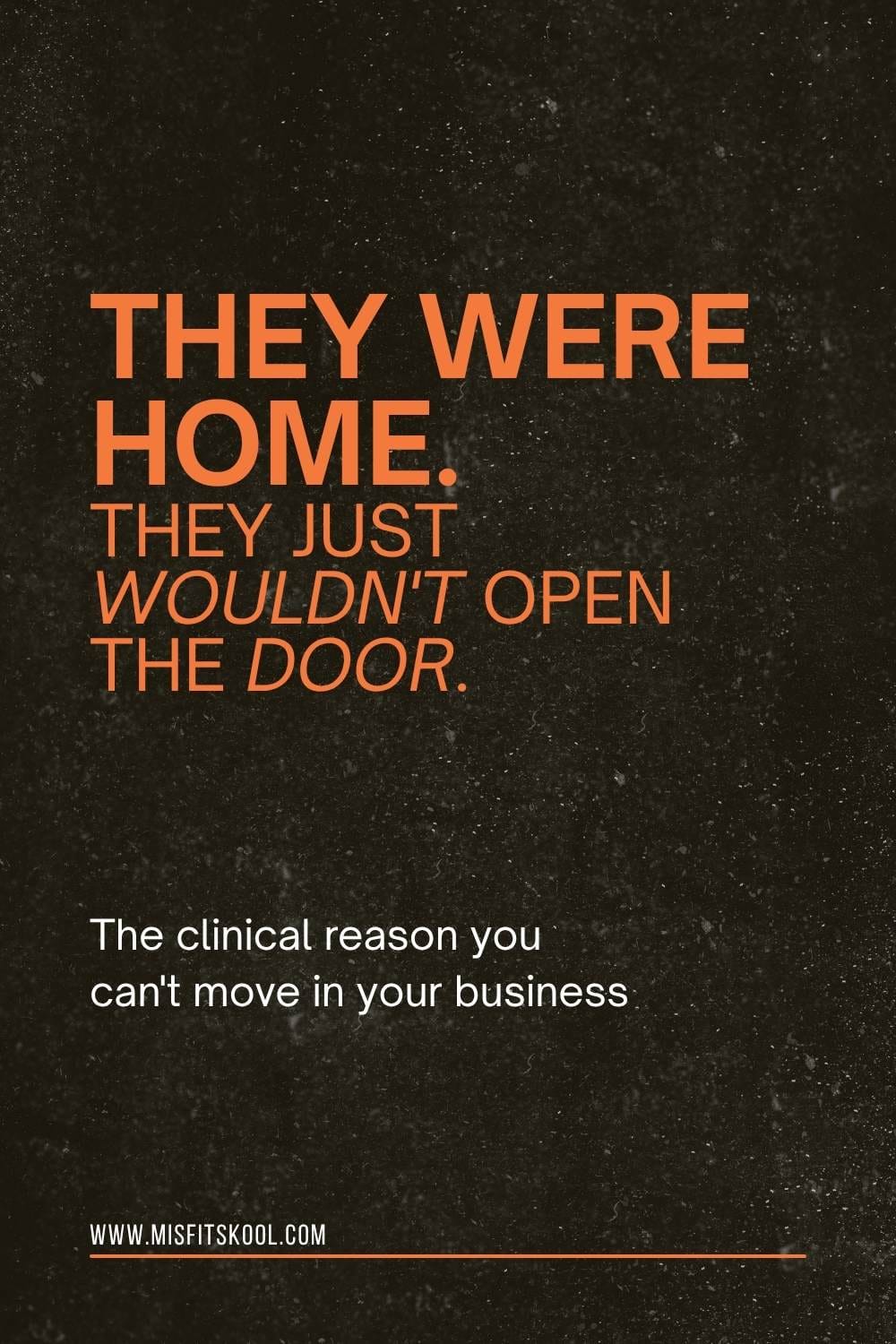
They Were Home. They Just Wouldn't Open the Door. (And Neither Will You — Until You Read This.)

I knocked on a lot of doors in 20 years of clinical social work.

Sometimes people weren't home.

But sometimes - and this is the part that never left me - sometimes they were home. I could hear them in there. Movement behind the door. A TV. A cough. A kid's voice.

They just wouldn't open it.

Not because they didn't need help. Not because they didn't want things to change. Not because they had somewhere better to be.

Because their nervous system ran a calculation - usually in about half a second - and decided that opening the door was more dangerous than whatever was on the other side of NOT opening it.

Even when not opening it had consequences they absolutely did not want.

I walked into the online business world in 2024 after 20 years of that work.

And I saw the exact same pattern wearing a ring light and a Canva template.

The entrepreneur who has the course. Has the strategy. Has the tools. Has genuinely tried.

And just... won't open the door.

Won't hit publish. Won't send the pitch. Won't launch the offer. Won't show up on camera. Won't do the thing they absolutely know they need to do.

And the entire online business industry's response to this is "you just need more discipline."

Twenty years of clinical social work says: no. You really don't.

What Is a Trauma-Informed Business Strategy?

It is a framework built on one clinical truth that most business education refuses to acknowledge.

Your nervous system comes to work with you.

Every day. Every launch. Every piece of content. Every sales conversation. Every time you sit down to do the thing that scares you.

Your attachment patterns come to work with you. Your scarcity conditioning comes to work with you. Your fear architecture comes to work with you. The part of your brain that learned - somewhere, sometime, from something - that visibility is dangerous? That comes to work with you too.

Most online business strategy assumes behavior is logical.

Clinical work teaches you behavior is protective.

That is the entire difference. And it changes everything about how you diagnose what is actually happening when someone can't seem to move.

A trauma-informed business strategy asks different questions.

Not "why won't you just be consistent" - but what does showing up consistently require this person to feel safe with?

Not "why do you keep self-sabotaging" - but what is the nervous system protecting against right now?

Not "is this procrastination" - but is this a freeze response? An avoidance response? A shutdown before perceived threat?

Most business spaces diagnose symptoms.

Clinically informed strategy diagnoses the underlying pattern first.

Diagnosis before prescription. Always.

That is the clinical edge. And nobody in this space has 20 years of evidence behind it.

Why Entrepreneurs Stay Stuck

Let me tell you what I watched happen with clients for two decades.

The avoidance was everywhere. And it was rarely about defiance. It was rarely about laziness. It was almost never about not caring.

People would skip things that HAD to be done. Important things. Court-mandated things. Things with real, documented consequences attached to them.

And the behavior looked irrational from the outside - until you understood what the nervous system was actually doing.

It was running a threat calculation.

What happened last time I did this? What happened last time I was visible, vulnerable, accountable, exposed? What happened last time I tried and it didn't work?

And if the answer to any of those questions was painful enough - the nervous system just... closed the door.

I see the exact same pattern in the online business world.

The entrepreneur who doesn't get good views on a video - and suddenly stops making videos.

The one who doesn't get a lead from a post - and quietly stops posting.

The one who doesn't do the prep work - and then avoids the thing the prep work was FOR.

The door is right there.

They are standing on the other side of it.

And the brain - doing exactly what it was designed to do - decides the risk isn't worth it.

That is not a discipline problem.

That is a nervous system problem.

And the distinction matters more than any content strategy you will ever buy.

The Clinical Psychology of Entrepreneurship

Entrepreneurship is one of the most psychologically exposing things a human being can voluntarily walk into.

You are attaching identity to visibility. Attaching survival to performance. Attaching worth to public response. Voluntarily placing yourself inside an environment built on uncertainty, comparison, rejection, instability, and judgment.

And then the online business world acts genuinely confused when entrepreneurs develop anxiety, avoidance, perfectionism, and burnout.

Of course they do.

The entrepreneur rewriting the sales page for the third week in a row instead of publishing it? That is not automatically perfectionism. It may be self-protection. The nervous system deciding that the imperfect version creates more danger than the version that never goes out.

The entrepreneur who has been learning for two years without launching anything? That is not laziness. That may be the nervous system buffering against a threat it cannot name but absolutely feels.

The entrepreneur who disappears every single time they start gaining momentum?

Classic approach-avoidance conflict.

The identity has not caught up with the opportunity yet. And the part of the brain responsible for keeping you safe starts pulling you back toward familiar ground.

That is textbook clinical psychology.

No morning routine fixes it. No mindset module touches it. No amount of "just believe in yourself" interrupts a pattern that has been running since before you ever heard the word entrepreneur.

Why Online Business Feels Unsafe

This is the conversation nobody in this space is having. And it is the one that matters most.

Online business feels unsafe for a lot of Misfit Entrepreneurs - not because they are fragile, not because they don't want success badly enough, but because it activates the exact psychological vulnerabilities they already walked in with.

Visibility can feel dangerous. Selling can feel dangerous. Being judged publicly can feel dangerous. Making real money can feel dangerous. Being SEEN - fully, unfiltered, in front of strangers on the internet - can feel genuinely dangerous.

Especially for people with histories that include chronic criticism, emotional invalidation, high-control environments, unpredictability, conditional love, shame-based achievement systems, or any experience that taught them that being visible created consequences.

And the online business world's answer to all of that is: "Just post more videos."

That is the equivalent of telling someone with a documented fear of heights to relax while pushing them out of a helicopter.

It is not helpful. It is not strategic. And from a clinical standpoint, it actively makes the pattern worse - because repeated exposure without safety doesn't build tolerance, it reinforces threat.

A trauma-informed business strategy understands that the nervous system requires safety before expansion.

Not coddling.

Safety.

Those are not the same thing - and knowing the difference is what 20 years of clinical training actually produces.

Trauma Response Procrastination Is Not Laziness

This might be the most misunderstood behavior in the entire online business space.

The freeze before hitting publish.

The inability to press post even after the caption is written and the image is ready.

The endless tweaking. The tab switching. The sudden exhaustion right before launch day. The overwhelming urge to reorganize your workspace when you are supposed to be selling. The disappearance pattern that shows up every single time visibility starts to increase.

That is not procrastination in the way the guru with the lambo thumbnail means it.

That is a trauma response.

Specifically - freeze, avoidance, and shutdown responses that exist to protect the nervous system from a perceived threat.

And the threat is not the Instagram post.

The threat is what the nervous system associates with what comes AFTER the post.

Judgment. Rejection. Failure. Humiliation. Conflict. Silence.

The specific flavor of pain that happened the last time you tried something and it didn't work the way you needed it to.

When entrepreneurs finally understand this, shame decreases. Sometimes dramatically.

And when shame decreases, behavior becomes more changeable.

Because shame has never once been an effective teaching tool in 20 years of clinical work.

Not once.

Self-Sabotage Psychology in Business

Everybody loves the phrase self-sabotage.

Almost nobody defines it correctly.

Self-sabotage is not stupidity. It is not weakness. It is not some mysterious force that randomly attacks ambitious people.

It is protection.

The brain prioritizes familiarity over potential. Even painful familiarity. Especially painful familiarity. Because the brain knows what painful and familiar costs - and it does not know what unfamiliar and potentially wonderful costs.

So when success starts to become real - when the thing you have been working toward actually starts to show up - the nervous system can perceive it as threat.

Because success means visibility. Visibility means exposure. Exposure means judgment. And judgment, for a lot of Misfit Entrepreneurs, has a long and painful track record.

So the nervous system creates distance from the thing it consciously wants.

That distance looks like overthinking instead of shipping. Delaying instead of deciding. Constant rebranding instead of building. Endless learning without a single implementation.

Starting completely over right when momentum was building. Underpricing. Refusing opportunities. Ghosting your own ideas.

You think: I need a better strategy.

Sometimes - often - you actually need an interrupter for the protection pattern underneath the strategy problem.

Those are completely different conversations. And most people in this space are not equipped to tell the difference.

Imposter Syndrome and Attachment Theory

Most people talk about imposter syndrome like it is a confidence issue.

It is not.

Clinically, imposter syndrome is often rooted in attachment disruption - the internalized belief, formed early, that your worth is conditional on performance. That love and approval were things you had to earn and could lose. That being seen fully - mistakes and all - was genuinely dangerous to your sense of belonging.

Fast-forward into entrepreneurship.

Every launch becomes emotional exposure. Every sales page becomes identity exposure. Every piece of content becomes relational exposure - because you are putting a version of yourself out into the world and waiting to find out whether it gets accepted or rejected.

No wonder entrepreneurs spiral before launches.

No wonder imposter syndrome shows up the hardest right when things are about to get real.

The online business world says fake it till you make it.

Twenty years of clinical training says: what early experience taught you that being seen was something you had to survive?

One of those questions produces sustainable change.

The other produces performance anxiety with a better Instagram aesthetic.

Scarcity Conditioning in Entrepreneurship

Scarcity conditioning is not a money mindset problem.

It is the internalization of instability - the nervous system's adaptation to chronic unpredictability around resources, safety, or belonging.

People who grew up inside financial chaos, emotional scarcity, or chronic unpredictability develop hypervigilance. The threat system stays activated. The body learns to scan for danger because danger was real and rest was not safe.

That hypervigilance does not politely wait outside when you open your laptop.

It follows you into every pricing decision, every investment, every slow month, every revenue fluctuation.

Which is why these entrepreneurs undercharge - not because they don't know their worth, but because charging full price feels dangerous. They overwork because rest triggers guilt or fear. They panic during normal slow seasons. They catastrophize metrics. They hoard information instead of sharing it. They avoid investments that could actually move things forward.

The internet calls this limiting beliefs.

Sometimes it is years of conditioned survival behavior that got someone through genuinely hard circumstances.

That distinction matters because people deserve precision - not vague motivational language dressed up as clinical insight.

Complex Trauma and Entrepreneurship

Complex trauma entrepreneurship is not about making your business into a therapy session.

It is about being honest about reality.

Entrepreneurship demands visibility, risk, uncertainty, self-trust, decision-making, emotional regulation, rejection tolerance, delayed gratification, and identity expansion.

All of those things become harder - not impossible, harder - when someone has lived inside chronic stress adaptation.

Here is what I want you to hear clearly though.

Many Misfit Entrepreneurs become exceptional - not despite their history, but because of the specific skills that history required them to develop.

Pattern recognition. Creativity. Adaptability. Emotional intelligence. Hyper-awareness. Strategic thinking under pressure. The ability to read a room and a relationship with a speed and accuracy that most people without that history never develop.

The Misfit is not broken.

The Misfit is running adaptations that were genuinely brilliant for the environment they were built in - and sometimes those adaptations need to be updated for the environment they are trying to build now.

That is a completely different conversation than "you need to fix yourself."

Window of Tolerance in Business

The window of tolerance is a clinical concept - the range within which a nervous system can function effectively without tipping into hyperarousal or shutdown.

Online entrepreneurship is basically a window-of-tolerance stress test that never ends.

Launches. Visibility spikes. Revenue drops. Negative comments. Public criticism. Comparison spirals. Algorithm changes. Financial unpredictability. The specific kind of silence that follows a launch that didn't go the way you needed it to.

All of it pushes people outside that window.

A trauma-informed business strategy helps Misfit Entrepreneurs expand that window over time - not by avoiding the hard things, but by building in ways that support capacity, regulation, and sustainability alongside performance.

Because a dysregulated entrepreneur cannot build consistently for long.

Eventually the nervous system collects its debt.

Every single time.

That is not weakness. That is biology. And no amount of hustle rebranding changes how biology works.

Life Coach vs Trauma-Informed Business Coach

The market is currently blurring this distinction aggressively and it matters that we name it clearly.

A life coach and a clinically informed business strategist are not the same credential, the same training, or the same conversation.

A clinically informed business strategist recognizes behavioral patterns through the lens of psychological adaptation, attachment theory, nervous system responses, and fear architecture. That lens comes from years of actual clinical training - not a certification weekend, not a TikTok psychology phase, not having personally overcome hard things.

The difference in practice is precision.

A traditional coach might say: you need more confidence.

A clinically informed strategist might say: you are entering freeze every time visibility increases because your nervous system has associated exposure with threat - and here is the specific interrupter for that pattern.

Those are not the same level of analysis.

Not remotely close.

And when you are trying to figure out why you cannot open the door - you need the person who has spent 20 years understanding exactly why people don't.

What Are the Best Trauma-Informed Business Consulting Services Available?

Most people searching this are actually looking for one thing underneath the search.

They want help that does not make them feel like a machine that is broken and needs fixing.

That is the real search.

When you are evaluating any trauma-informed business support - coaching, consulting, community, whatever form it takes - look for real psychological literacy. Ethical marketing that does not manufacture urgency or weaponize your insecurities to sell you something. Nervous system awareness that goes beyond buzzwords. The ability to tell the difference between clinically informed strategy and actual clinical treatment.

And - this one matters more than people realize - pay attention to how their content makes your nervous system feel.

Manipulative marketers create urgency spikes.

Ethical educators create clarity.

Your body usually recognizes the difference before your brain catches up.

Social Worker Turned Entrepreneur: Why This Framework Exists

I did not build Misfit Skool because I wanted to be an online business personality.

I built it because I could not unsee what was happening.

I watched hardworking people being blamed for failing inside broken systems for 20 years in clinical social work.

Then I walked into the online business world and watched it happen again.

Different environment. Same psychological patterns. Same internalized failure. Same people sitting on the other side of a door they knew they needed to open - and couldn't.

The online business world kept selling tactics to people who needed transformation underneath the tactics. And because nobody with actual clinical training was naming the real problem, entrepreneurs kept absorbing the failure as personal evidence that something was wrong with them.

That is not okay.

Misfit Skool exists to give Misfit Entrepreneurs the language for what is actually happening underneath the struggle - because when you can name the pattern correctly, you stop blaming yourself for surviving it.

And that is where real change starts.

Not with a better funnel.

Not with a new niche.

Not with more discipline.

With finally understanding why you're standing on the other side of the door - and what it actually takes to open it.

Trauma-Informed Business Strategy Is Not About Staying Small

This part matters and I will not bury it at the end.

Trauma-informed business strategy is not about fragility. It is not about removing ambition or lowering the standard or avoiding discomfort indefinitely.

Six figures is the floor. Say that without apologizing for it.

This is about understanding that sustainable expansion requires nervous system capacity - and that you cannot build a stable business while constantly operating inside survival mode.

The goal is not avoidance.

The goal is regulation strong enough to tolerate real growth.

That is different. Entirely different.

And it is the conversation the online business world should have been having all along - instead of selling discipline to people whose nervous systems were running protection patterns that discipline was never going to touch.

The Business Problem Might Not Be What You Think It Is

If you have been posting with little traction. Frozen around visibility. Terrified of selling. Chronically procrastinating. Undercharging. Disappearing right when momentum builds. Learning everything and implementing nothing. Feeling unsafe in a space you desperately want to succeed in.

I need you to hear this clearly.

That does not mean you are lazy. Incapable. Broken. Not cut out for this.

It may mean the strategy you were given never once accounted for the human nervous system trying to implement it.

And after 20 years in clinical social work - working with people navigating some of the hardest circumstances imaginable, watching nervous systems do extraordinary things to protect the people they belong to - I can tell you this with complete certainty.

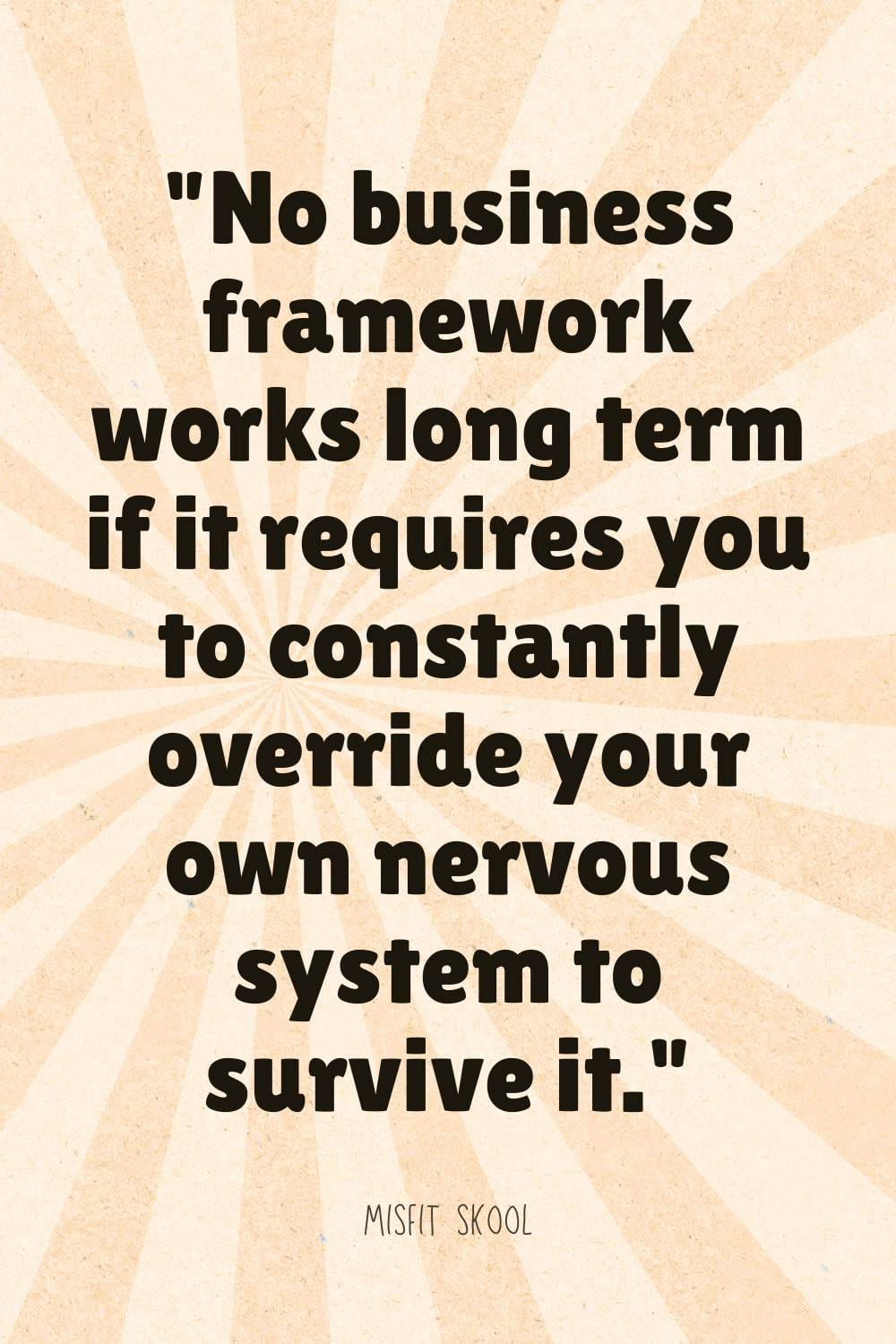
No business framework works long term if it requires someone to constantly override their own nervous system to survive it.

That is not sustainable entrepreneurship.

That is prolonged self-abandonment dressed up as ambition.

You are not the problem.

You were just given a map that was never drawn for someone like you.

Misfit Skool was.

Join Misfit Skool HERE or learn more HERE

Jess, licensed clinical social worker and founder of Misfit Skool

Jess

Licensed Clinical Social Worker · 20 Years · Founder, Misfit Skool

I spent 20 years as a clinical social worker watching the same patterns play out in people’s lives ~ the same protective behaviors, the same fear architecture, the same nervous systems doing exactly what they were designed to do. Then I walked into the online business world and saw the exact same thing wearing a ring light. I built Misfit Skool because the only method that actually works is one built for how real humans operate ~ not how gurus wish they did.

Not joining yet? That's fine.

Get the weekly clinical take instead. One pattern. One explanation. One thing to do. Written by a social worker who has seen your exact situation for 20 years - and built the only method that addresses the real cause.

Your email address is safe with us .We never share your information with anyone

Disclaimer

Misfit Skool is an online business education community. The content, curriculum, and coaching offered through Misfit Skool are for educational and informational purposes only. Nothing shared here constitutes therapy, clinical treatment, medical advice, or a therapeutic relationship of any kind.

Jess is a former professional clinical social worker whose 20-year career informs the educational framework and methodology taught inside Misfit Skool. That clinical background is the foundation of the method — it is not an offer of clinical services. No client-therapist relationship is created by joining or participating in Misfit Skool.

Results shared by members are real and represent their individual experiences. They are not guarantees. Your results will depend on your effort, your circumstances, and how you apply the method.

Misfit Skool is not affiliated with, endorsed by, or officially partnered with Skool.com. The Skool platform is used to host the community.

© 2026 Misfit Skool. All rights reserved.